رسّامون، شعراء، كتّاب · المعرض 24 / 29
في قلب الفن، في قلب الحياة…
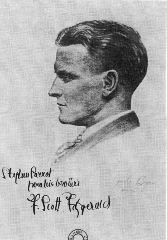
فرانسيس سكوت فيتزجيرالد 1896-1940
One Trip Abroad — «رحلة إلى الخارج»
رحلة إلى الخارج (ترجمة عربية للقسم الأول، الذي تجري أحداثه في بوسعادة؛ أما بقية القصة فمقدَّمة بنصّها الإنجليزي الأصلي)
I
في العصر اسودّ الجوّ بالجراد، فصرخت بعض النساء وهنّ يرتمين على أرضية الحافلة ويغطّين شعورهن بأغطية السفر. كان الجراد متّجهًا شمالًا، يلتهم كل ما في طريقه، ولم يكن ذلك كثيرًا في تلك الناحية من العالم؛ كان يطير صامتًا في خطوط مستقيمة، رقائق من ثلج أسود. لكن لم تصطدم جرادة واحدة بالزجاج الأمامي ولا سقطت داخل السيارة، وسرعان ما أخذ الظرفاء يمدّون أيديهم محاولين الإمساك ببعضها. وبعد عشر دقائق خفّت السحابة ومرّت، وخرجت النساء من تحت الأغطية، منكوشات الشعر يشعرن بالحماقة. وأخذ الجميع يتحدّثون معًا.
تحدّث الجميع؛ كان من العبث ألّا يتحدّثوا بعد أن عبروا سربًا من الجراد على حافة الصحراء الكبرى. تحدّث الأمريكي الإزميري إلى الأرملة البريطانية النازلة إلى بسكرة لتعيش مغامرة أخيرة مع شيخ لم تلقه بعدُ. وتحدّث عضو بورصة سان فرانسيسكو بخجل إلى الكاتب: «ألست كاتبًا؟» قال. وتحدّث الأب وابنته القادمان من ويلمنغتون إلى الطيّار اللندني الذي كان سيطير إلى تمبكتو. حتى السائق الفرنسي استدار وشرح بصوت عالٍ واضح: «نحل كبير»، فانفجرت الممرّضة القادمة من نيويورك في نوبات متتالية من الضحك الهستيري.
ووسط هذا التقارب الفجّ بين المسافرين كان هناك تبادل واحد أكثر تدبّرًا. فقد التفت السيد والسيدة ليدل مايلز كأنهما شخص واحد، وابتسما وكلّما الزوجين الأمريكيين الشابّين في المقعد الخلفي:
«ألم يعلق شيء منه بشعركما؟»
بادلهما الزوجان الشابّان الابتسام بأدب.
«لا. نجونا من ذلك الوباء.»
كانا في العشرينيات، ولا تزال عليهما لمسة لطيفة من العروسين. زوجان وسيمان؛ الرجل متوقّد مرهف الحسّ نوعًا ما، والفتاة لافتة بلون عينيها وشعرها الفاتح، ووجهها بلا ظلال، تعدّل نضارته الحيّة سكينةٌ واثقة جميلة. ولم يفت السيد والسيدة مايلز أن يلحظا مظهرهما الراقي، وخلفيتهما «الأنيقة» تحديدًا، التي تعبّر عنها بساطتهما وتحفّظهما المتأصّل الذي لم يكن تصلّبًا. وإن كانا يتباعدان عن الآخرين فلأنهما يكتفيان ببعضهما، أما تباعد السيد والسيدة مايلز عن بقية الركّاب فكان قناعًا واعيًا، وموقفًا اجتماعيًّا، شأنًا علنيًّا في جوهره كتقرّبات الأمريكي الإزميري المتطفّلة التي صدّه عنها الجميع.
والحقيقة أن آل مايلز قرّرا أن الزوجين الشابّين «مقبولان»، وقد ملّا نفسيهما، فكانا يتقرّبان منهما صراحةً.
«هل زرتما إفريقيا من قبل؟ إنها ساحرة إلى أبعد حدّ! هل تواصلان إلى تونس؟»
كان لآل مايلز، وإن أنهكتهما من الداخل خمس عشرة سنة في وسط معيّن بباريس، أسلوب لا يُنكر، بل جاذبية، وقبل الوصول مساءً إلى بلدة بوسعادة الواحية الصغيرة كان الأربعة قد صاروا رفاقًا. اكتشفوا أصدقاء مشتركين في نيويورك، والتقوا لتناول كوكتيل في حانة فندق الترانساتلانتيك، فقرّروا أن يتعشّوا معًا.
ولمّا نزل الزوجان كيلي الشابّان بعد ذلك، شعرت نيكول بشيء من الندم على قبولهما، إذ أدركت أنهما أصبحا الآن ملزمين على الأرجح برؤية معارفهما الجدد قدرًا من الوقت حتى قسنطينة، حيث تفترق طرقهم.
فقد كانت خلال الأشهر الثمانية من زواجهما سعيدة جدًّا حتى بدا لها ذلك إفسادًا لشيء ما. على الباخرة الإيطالية التي أقلّتهما إلى جبل طارق لم ينضمّا إلى الجماعات التي كانت تتّكئ بيأس على بعضها في الحانة؛ بل درسا الفرنسية بجدّ، واشتغل نيلسون بأعمال تتعلّق بميراثه الأخير البالغ نصف مليون دولار. ورسم أيضًا لوحة لمدخنة الباخرة. ولمّا اختفى أحد أفراد الجماعة المرحة في الحانة إلى الأبد في المحيط الأطلسي قبيل جزر الأزور، كاد الزوجان كيلي يفرحان، لأن ذلك برّر موقفهما المتحفّظ.
لكن كان هناك سبب آخر لأسف نيكول على التزامهما. فكلّمت نيلسون في ذلك: «مررت قبل قليل بذلك الزوجين في الرواق.»
«من؟ آل مايلز؟»
«لا، ذلك الزوجان الشابّان — في مثل سنّنا تقريبًا — اللذان كانا في الحافلة الأخرى، واللذان بدَوا لنا لطيفين جدًّا، في بئر الرابالو بعد الغداء، في سوق الجمال.»
«بدَوا لطيفين فعلًا.»
«فاتنين»، قالت بتأكيد، «الفتاة والرجل كلاهما. أكاد أكون متأكّدة أنني التقيت بالفتاة في مكان ما من قبل.»
كان الزوجان المقصودان جالسين في الطرف الآخر من القاعة على العشاء، ووجدت نيكول عينيها منجذبتين إليهما على نحو لا يقاوَم. كان لهما هما أيضًا رفاق الآن، ومرة أخرى شعرت نيكول، التي لم تتحدّث إلى فتاة في سنّها منذ شهرين، بندم خفيف. أما آل مايلز، المتمرّسان شكلًا والمتعاليان صراحةً، فكانا أمرًا آخر. لقد زارا عددًا مخيفًا من الأماكن، وبدا أنهما يعرفان كل الأطياف اللامعة في الصحف.
تعشّوا في شرفة الفندق تحت سماء منخفضة مملوءة بحضور إله غريب يقظ؛ وحول زوايا الفندق كان الليل يضطرب بالأصوات التي طالما قرأوا عنها، لكنها بقيت مع ذلك غريبة عليهم إلى حدّ الهستيريا: طبول من السنغال، ناي محلّي، رغاء الجمل الأناني المخنّث، العرب يمرّون بخطى خفيفة في نعال مصنوعة من إطارات سيارات قديمة، نحيب صلاة المجوس.
وعند مكتب الاستقبال كان أحد رفاق السفر يجادل الموظف بنبرة رتيبة في سعر الصرف، وزاد هذا التنافر من الانفصال الذي ما فتئ يزداد كلما اتّجهوا جنوبًا.
كانت السيدة مايلز أول من كسر الصمت المتمادي؛ فسحبتهم معها بنوع من نفاد الصبر، من الليل إلى الداخل وإلى المائدة.
«كان علينا حقًّا أن نرتدي ملابس السهرة. العشاء أمتع حين يتأنّق الناس، لأنهم يشعرون بشكل مختلف في الملابس الرسمية. الإنجليز يعرفون ذلك.»
«نتأنّق هنا؟» اعترض زوجها. «سأشعر كذلك الرجل ببذلة السهرة الممزّقة الذي مررنا به اليوم يسوق قطيع الغنم.»
«أشعر دائمًا أنني سائحة إن لم أكن متأنّقة.»
«حسنًا، ألسنا سيّاحًا؟» سأل نيلسون.
«لا أعدّ نفسي سائحة. السائح هو من يستيقظ باكرًا ويذهب إلى الكاتدرائيات ويتحدّث عن المناظر.»
اعترفت نيكول ونيلسون، وقد شاهدا كل المعالم الرسمية من فاس إلى الجزائر العاصمة، والتقطا بكرات من الأفلام، وشعرا بأنهما ارتقيا، بأنهما من هؤلاء، لكنهما قرّرا أن تجاربهما في الرحلة لن تهمّ السيدة مايلز.
«كل الأماكن متشابهة»، تابعت السيدة مايلز. «الشيء الوحيد المهم هو من يوجد فيها. المناظر الجديدة جميلة لنصف ساعة، لكنك بعد ذلك تريد أن ترى أمثالك. لذلك تحظى بعض الأماكن برواج معيّن، ثم يتغيّر الرواج فينتقل الناس إلى مكان آخر. المكان نفسه لا يهمّ في الحقيقة أبدًا.»
«لكن أليس هناك من يقرّر أولًا أن المكان جميل؟» اعترض نيلسون. «الأوائل يذهبون إليه لأنهم يحبّون المكان.»
«إلى أين كنتما ذاهبين هذا الربيع؟» سألت السيدة مايلز.
«فكّرنا في سان ريمو، أو ربما سورينتو. لم نزر أوروبا من قبل.»
«يا ولديّ، أعرف سورينتو وسان ريمو كلتيهما، ولن تطيقا أيًّا منهما أسبوعًا. إنهما مليئتان بأفظع الإنجليز، يقرأون الديلي ميل وينتظرون الرسائل ويتحدّثون في أشدّ الأمور مللًا. الأجدر بكما أن تذهبا إلى برايتون أو بورنموث وتشتريا كلبًا أبيض من فصيلة البودل ومظلّة وتتمشّيا على الرصيف البحري. كم ستبقيان في أوروبا؟»
«لا ندري؛ ربما سنوات عدّة.» تردّدت نيكول. «ورث نيلسون بعض المال، وأردنا تغييرًا. حين كنت صغيرة كان أبي مصابًا بالربو، فاضطررت إلى العيش معه سنوات في أكثر المصحّات كآبة؛ وكان نيلسون يعمل في تجارة الفراء في ألاسكا ويمقتها؛ فلمّا تحرّرنا جئنا إلى الخارج. سيرسم نيلسون وسأدرس أنا الغناء.» ونظرت إلى زوجها منتصرة. «كان كل شيء حتى الآن رائعًا تمامًا.»
استنتجت السيدة مايلز من ثياب المرأة الأصغر أن المال كان كثيرًا، وكان حماسهما معديًا.
«يجب حقًّا أن تذهبا إلى بياريتز»، نصحتهما. «أو تعالا إلى مونتي كارلو.»
«يقولون لي إن هنا عرضًا رائعًا»، قال مايلز وهو يطلب الشمبانيا. «أولاد نايل. يقول البوّاب إنهن نوع من قبيلة من الفتيات ينزلن من الجبال ويتعلّمن الرقص وما إلى ذلك، حتى يجمعن ما يكفي من الذهب للعودة إلى جبالهن والزواج. حسنًا، لديهن عرض الليلة.»
وهم يمشون بعد ذلك نحو مقهى أولاد نايل، أسفت نيكول لأنها ونيلسون لا يتنزّهان وحدهما في الليل الذي يزداد انخفاضًا ونعومة وإشراقًا. كان نيلسون قد ردّ زجاجة الشمبانيا على العشاء بأخرى، ولم يكن أيّ منهما معتادًا على هذا القدر. ولمّا اقتربا من الناي الحزين لم ترغب في الدخول، بل في أن تصعد إلى قمّة تلّ منخفض حيث يلمع مسجد أبيض صافيًا ككوكب في الليل. كانت الحياة أجمل من أيّ عرض؛ فاقتربت من نيلسون وضغطت على يده.
كان كهف المقهى الصغير مليئًا بركّاب الحافلتين. وكانت الفتيات — أمازيغيات سمراوات فاتحات، فطساوات الأنوف، بعيون جميلة عميقة الظلال — قد أخذت كل واحدة منهن تؤدّي رقصتها المنفردة على المنصّة. كنّ يرتدين فساتين قطنية تذكّر قليلًا بمربّيات الجنوب الأمريكي؛ وتحتها كانت أجسادهن تتلوّى في رقصة بطيئة، تبلغ ذروتها في رقصة البطن، والأحزمة الفضية تهتزّ بعنف وسلاسل القطع الذهبية الحقيقية ترنّ على أعناقهن وأذرعهن. وكان عازف الناي مهرّجًا أيضًا؛ يرقص محاكيًا الفتيات بسخرية. أما ضارب الطبل، الملفوف في جلود الماعز كساحر قبيلة، فكان أسود حقيقيًّا من السودان.
وعبر دخان السجائر كانت كل فتاة تؤدّي بدورها حركة الأصابع، كأنها تعزف على البيانو في الهواء — سهلة في الظاهر، لكنها تبدو بعد لحظات شديدة الصعوبة — ثم خطوات القدمين البسيطة الفاترة جدًّا والدقيقة بالقدر نفسه — ولم يكن ذلك كله إلا تمهيدًا للشهوانية الجامحة لذروة الرقص.
ثم كانت فترة هدوء. ومع أن العرض لم يبدُ منتهيًا تمامًا، أخذ معظم الحاضرين ينهضون تدريجيًّا للانصراف، لكن همسًا كان يسري في الجوّ.
«ما الأمر؟» سألت نيكول زوجها.
«يبدو لي — يبدو أن أولاد نايل، لقاء مقابل، يرقصن على الطريقة — آه — الشرقية إلى حدّ ما — لا يلبسن تقريبًا إلا الحليّ.»
«آه.»
«سنبقى كلّنا»، طمأنها السيد مايلز بمرح. «ففي النهاية نحن هنا لنرى العادات والأعراف الحقيقية للبلاد؛ ولا ينبغي أن يقف في طريقنا شيء من الحياء المتزمّت.»
بقي معظم الرجال، وعدد من النساء. فنهضت نيكول فجأة.
«سأنتظر في الخارج»، قالت.
«لماذا لا تبقين يا نيكول؟ ففي النهاية السيدة مايلز باقية.»
كان عازف الناي يؤدّي زخارف تمهيدية. وعلى المنصّة المرتفعة كانت طفلتان سمراوان شاحبتان في نحو الرابعة عشرة تنزعان فستانيهما القطنيّين. تردّدت نيكول لحظة، ممزّقة بين النفور والرغبة في ألّا تبدو متزمّتة. ثم رأت امرأة أمريكية شابّة أخرى تنهض بسرعة وتتّجه نحو الباب. ولمّا عرفت فيها الزوجة الشابّة الجذّابة من الحافلة الأخرى حسمت قرارها بسرعة وتبعتها.
أسرع نيلسون خلفها. «سأذهب إن ذهبتِ»، قال، لكن بتردّد واضح.
«أرجوك لا تُتعب نفسك. سأنتظر مع الدليل في الخارج.»
«حسنًا…» كان الطبل قد بدأ. فتوصّل إلى حلّ وسط: «لن أبقى إلا دقيقة. أريد أن أرى كيف هو الأمر.»
وهي تنتظر في الليل المنعش، وجدت أن الحادثة جرحتها: أن نيلسون لم يأتِ معها في الحال، متذرّعًا ببقاء السيدة مايلز. ومن الجرح انتقلت إلى الغضب، فأشارت إلى الدليل بأنها تريد العودة إلى الفندق.
وبعد عشرين دقيقة ظهر نيلسون، غاضبًا من القلق حين وجدها قد رحلت، وليخفي أيضًا إحساسه بالذنب لأنه تركها. ووجدا نفسيهما فجأة، وهما لا يصدّقان، في شجار.
وبعد وقت طويل، حين لم يبقَ أيّ صوت في بوسعادة، ولم يعد البدو في ساحة السوق سوى صُرَر ساكنة ملفوفة في برانسهم، كانت نائمة على كتفه. الحياة تمضي قُدُمًا مهما كانت نوايانا، لكن شيئًا ما قد أصابه الأذى، وسابقة ما لاختلاف ممكن قد وُضعت. ومع ذلك كان زواج حبّ، وكان قادرًا على احتمال الكثير. فقد عاشت هي ونيلسون شبابًا موحشًا، وكانا يريدان الآن طعم العالم الحيّ ورائحته؛ وكانا يجدانهما في الوقت الحاضر في بعضهما.
بعد شهر كانا في سورينتو، حيث أخذت نيكول دروسًا في الغناء وحاول نيلسون أن يرسم شيئًا جديدًا في خليج نابولي. كانت الحياة التي خطّطا لها وطالما قرآ عنها. لكنهما وجدا، كما وجد كثيرون، أن سحر الفواصل الهانئة يتوقّف على شخص «يقيم الحفل» — أي يوفّر الخلفية والتجربة والصبر التي يبدو الآخر على ضوئها مستمتعًا من جديد بلحظات السكينة الريفية المستعادة من الطفولة. كان نيكول ونيلسون أكبر وأصغر معًا، وأمريكيّين أكثر من اللازم، لينسجما فورًا وبلين مع بلد غريب. كانت حيويتهما تجعلهما قلقين، إذ لم يكن لرسمه اتجاه بعدُ، ولا لغنائها أفق قريب للجدّية. كانا يقولان إنهما «لا يصلان إلى شيء» — وكانت الأمسيات طويلة، فأخذا يشربان كثيرًا من نبيذ كابري على العشاء.
كان الإنجليز يملكون الفندق. كانوا مسنّين، جاؤوا إلى الجنوب طلبًا للطقس الجميل والسكينة؛ وكان نيلسون ونيكول يستاءان من رتابة أيامهم الهادئة. أيمكن أن يقنع الناس بالحديث الأبدي عن الطقس، والتنزّه في الممشى نفسه، ومواجهة الصنف نفسه من المعكرونة على العشاء شهرًا بعد شهر؟ أصابهما الملل، والأمريكيون إذا ملّوا صاروا على مرمى حجر من الإثارة. وبلغت الأمور ذروتها في ليلة واحدة.
على قارورة نبيذ في العشاء قرّرا الذهاب إلى باريس، والاستقرار في شقّة، والعمل بجدّ. كانت باريس تَعِد بتسلية المدن الكبرى، وبأصدقاء في سنّهما، وبحدّة عامّة كانت تنقص إيطاليا. ولمّا دخلا الصالون بعد العشاء، متحمّسين لآمالهما الجديدة، لاحظ نيلسون للمرة العاشرة بيانو آليًّا قديمًا ضخمًا، فدفعه شيء إلى تجربته.
وفي الطرف الآخر من الصالون كان يجلس الإنجليزيان الوحيدان اللذان كانت لهما بهما صلة — الجنرال السير إيفلين فراجيل والسيدة فراجيل. وكانت الصلة قصيرة وغير سارّة — فحين رأتهما يخرجان من الفندق بالأرواب ليسبحا، أعلنت، عبر أمتار عديدة من الأرضية، أن ذلك مقرف ولا ينبغي السماح به.
لكن ذلك لم يكن شيئًا إلى جانب ردّ فعلها على أولى الانفجارات الصوتية الرهيبة للبيانو الكهربائي. فبينما كان غبار السنين يرتجف عن لوحة المفاتيح من شدّة الاهتزاز، اندفعت إلى الأمام كالمصعوقة بنوع الانتفاضة المرتبط بالكرسي الكهربائي. وما كاد نيلسون، المذهول هو نفسه من الضجيج المفاجئ لأغنية «في انتظار روبرت إي. لي»، يجلس حتى قذفت بنفسها عبر الغرفة، وذيل ثوبها يرتجف خلفها، وأطفأت الآلة دون أن تلتفت إلى آل كيلي.
كانت من تلك الحركات التي إمّا أن تكون مبرّرة تمامًا وإمّا شائنة. تردّد نيلسون لحظة غير متأكّد؛ ثم تذكّر ملاحظة السيدة فراجيل المتعجرفة عن ثوب سباحته، فعاد إلى الآلة في أعقابها التي لا تزال تتموّج وأدارها من جديد.
صارت الحادثة دولية. وتعلّقت عيون الصالون كلّه بلهفة بطرفي النزاع، تترقّب الحركة التالية. أسرعت نيكول خلف نيلسون تحثّه على ترك الأمر، لكن الأوان كان قد فات. فمن المائدة الإنجليزية الغاضبة نهض، مفصلًا بعد مفصل، الجنرال السير إيفلين فراجيل، يواجه ربما أخطر موقف عرفه منذ فكّ الحصار عن ليديسميث.
«شائن تمامًا!… شائن تمامًا!»
«عفوًا؟» قال نيلسون.
«هنا منذ خمس عشرة سنة!» صاح السير إيفلين لنفسه. «لم أسمع قطّ بأحد يفعل مثل هذا!»
«فهمت أن هذه الآلة وُضعت هنا لتسلية النزلاء.»
ترفّع السير إيفلين عن الجواب، وجثا ومدّ يده إلى المزلاج، فدفعه في الاتجاه الخطأ، فتضاعفت سرعة الآلة وصوتها ثلاث مرات حتى وقفا في هرج صوتي جامح؛ السير إيفلين شاحب من انفعالات عسكرية، ونيلسون على وشك ضحك جنوني.
وفي لحظة حسمت يد مدير الفندق الحازمة الأمر؛ فشهقت الآلة وتوقّفت، مرتجفة قليلًا من انفجارها غير المعتاد، تاركة خلفها صمتًا كبيرًا التفت فيه السير إيفلين إلى المدير.
«أشنع قضية سمعت بها في حياتي. أطفأتها زوجتي مرة، وهو» — وكان هذا أول اعتراف منه بأن لنيلسون هوية متميّزة عن الآلة — «هو أدارها من جديد!»
«هذه قاعة عامة في فندق»، احتجّ نيلسون. «والآلة موجودة هنا على ما يبدو لتُستعمل.»
«لا تدخل في جدال»، همست نيكول. «إنهما مسنّان.»
لكن نيلسون قال: «إن كان هناك اعتذار، فهو مستحقّ لي بالتأكيد.»
كانت عين السير إيفلين مثبّتة بتهديد على المدير، تنتظر منه أن يؤدّي واجبه. وفكّر هذا الأخير في خمس عشرة سنة من إقامة السير إيفلين، فانكمش.
«ليس من العادة العزف على الآلة في المساء. الزبائن كلّ واحد منهم هادئ على مائدته.»
«وقاحة أمريكية!» قال السير إيفلين بحدّة.
«حسنًا جدًّا»، قال نيلسون؛ «سنريح الفندق من وجودنا غدًا.»
وكردّ فعل على هذه الحادثة، وكنوع من الاحتجاج على السير إيفلين فراجيل، لم يذهبا إلى باريس بل إلى مونتي كارلو في نهاية المطاف. لقد انتهيا من العزلة.
II
A little more than two years after the Kellys' first visit to Monte Carlo, Nicole woke up one morning into what, though it bore the same name, had become to her a different place altogether.
In spite of hurried months in Paris or Biarritz, it was now home to them. They had a villa, they had a large acquaintance among the spring and summer crowd--a crowd which, naturally, did not include people on charted trips or the shore parties from Mediterranean cruises; these latter had become for them "tourists."
They loved the Riviera in full summer with many friends there and the nights open and full of music. Before the maid drew the curtains this morning to shut out the glare, Nicole saw from her window the yacht of T. F. Golding, placid among the swells of the Monacan Bay, as if constantly bound on a romantic voyage not dependent upon actual motion.
The yacht had taken the slow tempo of the coast; it had gone no farther than to Cannes and back all summer, though it might have toured the world. The Kellys were dining on board that night.
Nicole spoke excellent French; she had five new evening dresses and four others that would do; she had her husband; she had two men in love with her, and she felt sad for one of them. She had her pretty face. At 10:30 she was meeting a third man, who was just beginning to be in love with her "in a harmless way." At one she was having a dozen charming people to luncheon. All that.
"I'm happy," she brooded toward the bright blinds. "I'm young and good-looking, and my name is often in the paper as having been here and there, but really I don't care about shi-shi. I think it's all awfully silly, but if you do want to see people, you might as well see the chic, amusing ones; and if people call you a snob, it's envy, and they know it and everybody knows it."
She repeated the substance of this to Oscar Dane on the Mont Agel golf course two hours later, and he cursed her quietly.
"Not at all," he said. "You're just getting to be an old snob. Do you call that crowd of drunks you run with amusing people? Why, they're not even very swell. They're so hard that they've shifted down through Europe like nails in a sack of wheat, till they stick out of it a little into the Mediterranean Sea."
Annoyed, Nicole fired a name at him, but he answered: "Class C. A good solid article for beginners."
"The Colbys--anyway, her."
"Third flight."
"Marquis and Marquise de Kalb."
"If she didn't happen to take dope and he didn't have other peculiarities."
"Well, then, where are the amusing people?" she demanded impatiently.
"Off by themselves somewhere. They don't hunt in herds, except occasionally."
"How about you? You'd snap up an invitation from every person I named. I've heard stories about you wilder than any you can make up. There's not a man that's known you six months that would take your check for ten dollars. You're a sponge and a parasite and everything--"
"Shut up for a minute," he interrupted. "I don't want to spoil this drive. . . . I just don't like to see you kid yourself," he continued. "What passes with you for international society is just about as hard to enter nowadays as the public rooms at the Casino; and if I can make my living by sponging off it, I'm still giving twenty times more than I get. We dead heats are about the only people in it with any stuff, and we stay with it because we have to."
She laughed, liking him immensely, wondering how angry Nelson would be when he found that Oscar had walked off with his nail scissors and his copy of the New York Herald this morning.
"Anyhow," she thought afterward, as she drove home toward luncheon, "we're getting out of it all soon, and we'll be serious and have a baby. After this last summer."
Stopping for a moment at a florist's, she saw a young woman coming out with an armful of flowers. The young woman glanced at her over the heap of color, and Nicole perceived that she was extremely smart, and then that her face was familiar. It was someone she had known once, but only slightly; the name had escaped her, so she did not nod, and forgot the incident until that afternoon.
They were twelve for luncheon: The Goldings' party from the yacht, Liddell and Cardine Miles, Mr. Dane--seven different nationalities she counted; among them an exquisite young French-woman, Madame Delauney, whom Nicole referred to lightly as "Nelson's girl." Noel Delauney was perhaps her closest friend; when they made up foursomes for golf or for trips, she paired off with Nelson; but today, as Nicole introduced her to someone as "Nelson's girl," the bantering phrase filled Nicole with distaste.
She said aloud at luncheon: "Nelson and I are going to get away from it all."
Everybody agreed that they, too, were going to get away from it all.
"It's all right for the English," someone said, "because they're doing a sort of dance of death--you know, gayety in the doomed fort, with the Sepoys at the gate. You can see it by their faces when they dance--the intensity. They know it and they want it, and they don't see any future. But you Americans, you're having a rotten time. If you want to wear the green hat or the crushed hat, or whatever it is, you always have to get a little tipsy."
"We're going to get away from it all," Nicole said firmly, but something within her argued: "What a pity--this lovely blue sea, this happy time." What came afterward? Did one just accept a lessening of tension? It was somehow Nelson's business to answer that. His growing discontent that he wasn't getting anywhere ought to explode into a new life for both of them, or rather a new hope and content with life. That secret should be his masculine contribution.
"Well, children, good-by."
"It was a great luncheon."
"Don't forget about getting away from it all."
"See you when--"
The guests walked down the path toward their cars. Only Oscar, just faintly flushed on liqueurs, stood with Nicole on the veranda, talking on and on about the girl he had invited up to see his stamp collection. Momentarily tired of people, impatient to be alone, Nicole listened for a moment and then, taking a glass vase of flowers from the luncheon table, went through the French windows into the dark, shadowy villa, his voice following her as he talked on and on out there.
It was when she crossed the first salon, still hearing Oscar's monologue on the veranda, that she began to hear another voice in the next room, cutting sharply across Oscar's voice.
"Ah, but kiss me again," it said, stopped; Nicole stopped, too, rigid in the silence, now broken only by the voice on the porch.
"Be careful." Nicole recognized the faint French accent of Noel Delauney.
"I'm tired of being careful. Anyhow, they're on the veranda."
"No, better the usual place."
"Darling, sweet darling."
The voice of Oscar Dane on the veranda grew weary and stopped and, as if thereby released from her paralysis, Nicole took a step--forward or backward, she did not know which. At the sound of her heel on the floor, she heard the two people in the next room breaking swiftly apart.
Then she went in. Nelson was lighting a cigarette; Noel, with her back turned, was apparently hunting for hat or purse on a chair. With blind horror rather than anger, Nicole threw, or rather pushed away from her, the glass vase which she carried. If at anyone, it was at Nelson she threw it, but the force of her feeling had entered the inanimate thing; it flew past him, and Noel Delauney, just turning about, was struck full on the side of her head and face.
"Say, there!" Nelson cried. Noel sank slowly into the chair before which she stood, her hand slowly rising to cover the side of her face. The jar rolled unbroken on the thick carpet, scattering its flowers.
"You look out!" Nelson was at Noel's side, trying to take the hand away to see what had happened.
"C'est liquide," gasped Noel in a whisper. "Est-ce que c'est le sang?"
He forced her hand away, and cried breathlessly, "No, it's just water!" and then, to Oscar, who had appeared in the doorway: "Get some cognac!" and to Nicole: "You fool, you must be crazy!"
Nicole, breathing hard, said nothing. When the brandy arrived, there was a continuing silence, like that of people watching an operation, while Nelson poured a glass down Noel's throat. Nicole signaled to Oscar for a drink, and, as if afraid to break the silence without it, they all had a brandy. Then Noel and Nelson spoke at once:
"If you can find my hat--"
"This is the silliest--"
"--I shall go immediately."
"--thing I ever saw; I--"
They all looked at Nicole, who said: "Have her car drive right up to the door." Oscar departed quickly.
"Are you sure you don't want to see a doctor?" asked Nelson anxiously.
"I want to go."
A minute later, when the car had driven away, Nelson came in and poured himself another glass of brandy. A wave of subsiding tension flowed over him, showing in his face; Nicole saw it, and saw also his gathering will to make the best he could of it.
"I want to know just why you did that," he demanded. "No, don't go, Oscar." He saw the story starting out into the world.
"What possible reason--"
"Oh, shut up!" snapped Nicole.
"If I kissed Noel, there's nothing so terrible about it. It's of absolutely no significance."
She made a contemptuous sound. "I heard what you said to her."
"You're crazy."
He said it as if she were crazy, and wild rage filled her.
"You liar! All this time pretending to be so square, and so particular what I did, and all the time behind my back you've been playing around with that little--"
She used a serious word, and as if maddened with the sound of it, she sprang toward his chair. In protection against this sudden attack, he flung up his arm quickly, and the knuckles of his open hand struck across the socket of her eye. Covering her face with her hand as Noel had done ten minutes previously, she fell sobbing to the floor.
"Hasn't this gone far enough?" Oscar cried.
"Yes," admitted Nelson, "I guess it has."
"You go on out on the veranda and cool off."
He got Nicole to a couch and sat beside her, holding her hand.
"Brace up--brace up, baby," he said, over and over. "What are you--Jack Dempsey? You can't go around hitting French women; they'll sue you."
"He told her he loved her," she gasped hysterically. "She said she'd meet him at the same place. . . . Has he gone there now?"
"He's out on the porch, walking up and down, sorry as the devil that he accidentally hit you, and sorry he ever saw Noel Delauney."
"Oh, yes!"
"You might have heard wrong, and it doesn't prove a thing, anyhow."
After twenty minutes, Nelson came in suddenly and sank down on his knees by the side of his wife. Mr. Oscar Dane, reënforced in his idea that he gave much more than he got, backed discreetly and far from unwillingly to the door.
In another hour, Nelson and Nicole, arm in arm, emerged from their villa and walked slowly down to the Café de Paris. They walked instead of driving, as if trying to return to the simplicity they had once possessed, as if they were trying to unwind something that had become visibly tangled. Nicole accepted his explanations, not because they were credible, but because she wanted passionately to believe them. They were both very quiet and sorry.
The Café de Paris was pleasant at that hour, with sunset drooping through the yellow awnings and the red parasols as through stained glass. Glancing about, Nicole saw the young woman she had encountered that morning. She was with a man now, and Nelson placed them immediately as the young couple they had seen in Algeria, almost three years ago.
"They've changed," he commented. "I suppose we have, too, but not so much. They're harder-looking and he looks dissipated. Dissipation always shows in light eyes rather than in dark ones. The girl is tout ce qu'il y a de chic, as they say, but there's a hard look in her face too."
"I like her."
"Do you want me to go and ask them if they are that same couple?"
"No! That'd be like lonesome tourists do. They have their own friends."
At that moment people were joining them at their table.
"Nelson, how about tonight?" Nicole asked a little later. "Do you think we can appear at the Goldings' after what's happened?"
"We not only can but we've got to. If the story's around and we're not there, we'll just be handing them a nice juicy subject of conversation. . . . Hello! What on earth--"
Something strident and violent had happened across the café; a woman screamed and the people at one table were all on their feet, surging back and forth like one person. Then the people at the other tables were standing and crowding forward; for just a moment the Kellys saw the face of the girl they had been watching, pale now, and distorted with anger. Panic-stricken, Nicole plucked at Nelson's sleeve.
"I want to get out. I can't stand any more today. Take me home. Is everybody going crazy?"
On the way home, Nelson glanced at Nicole's face and perceived with a start that they were not going to dinner on the Goldings' yacht after all. For Nicole had the beginnings of a well-defined and unmistakable black eye--an eye that by eleven o'clock would be beyond the aid of all the cosmetics in the principality. His heart sank and he decided to say nothing about it until they reached home.
III
There is some wise advice in the catechism about avoiding the occasions of sin, and when the Kellys went up to Paris a month later they made a conscientious list of the places they wouldn't visit any more and the people they didn't want to see again. The places included several famous bars, all the night clubs except one or two that were highly decorous, all the early-morning clubs of every description, and all summer resorts that made whoopee for its own sake--whoopee triumphant and unrestrained--the main attraction of the season.
The people they were through with included three-fourths of those with whom they had passed the last two years. They did this not in snobbishness, but for self-preservation, and not without a certain fear in their hearts that they were cutting themselves off from human contacts forever.
But the world is always curious, and people become valuable merely for their inaccessibility. They found that there were others in Paris who were only interested in those who had separated from the many. The first crowd they had known was largely American, salted with Europeans; the second was largely European, peppered with Americans. This latter crowd was "society," and here and there it touched the ultimate milieu, made up of individuals of high position, of great fortune, very occasionally of genius, and always of power. Without being intimate with the great, they made new friends of a more conservative type. Moreover, Nelson began to paint again; he had a studio, and they visited the studios of Brancusi and Leger and Deschamps. It seemed that they were more part of something than before, and when certain gaudy rendezvous were mentioned, they felt a contempt for their first two years in Europe, speaking of their former acquaintances as "that crowd" and as "people who waste your time."
So, although they kept their rules, they entertained frequently at home and they went out to the houses of others. They were young and handsome and intelligent; they came to know what did go and what did not go, and adapted themselves accordingly. Moreover, they were naturally generous and willing, within the limits of common sense, to pay.
When one went out one generally drank. This meant little to Nicole, who had a horror of losing her soigné air, losing a touch of bloom or a ray of admiration, but Nelson, thwarted somewhere, found himself quite as tempted to drink at these small dinners as in the more frankly rowdy world. He was not a drunk, he did nothing conspicuous or sodden, but he was no longer willing to go out socially without the stimulus of liquor. It was with the idea of bringing him to a serious and responsible attitude that Nicole decided after a year in Paris, that the time had come to have a baby.
This was coincidental with their meeting Count Chiki Sarolai. He was an attractive relic of the Austrian court, with no fortune or pretense to any, but with solid social and financial connections in France. His sister was married to the Marquis de la Clos d'Hirondelle, who, in addition to being of the ancient noblesse, was a successful banker in Paris. Count Chiki roved here and there, frankly sponging, rather like Oscar Dane, but in a different sphere.
His penchant was Americans; he hung on their words with a pathetic eagerness, as if they would sooner or later let slip their mysterious formula for making money. After a casual meeting, his interest gravitated to the Kellys. During Nicole's months of waiting he was in the house continually, tirelessly interested in anything that concerned American crime, slang, finance or manners. He came in for a luncheon or dinner when he had no other place to go, and with tacit gratitude he persuaded his sister to call on Nicole, who was immensely flattered.
It was arranged that when Nicole went to the hospital he would stay at the appartement and keep Nelson company--an arrangement of which Nicole didn't approve, since they were inclined to drink together. But the day on which it was decided, he arrived with news of one of his brother-in-law's famous canal-boat parties on the Seine, to which the Kellys were to be invited and which, conveniently enough, was to occur three weeks after the arrival of the baby. So, when Nicole moved out to the American Hospital Count Chiki moved in.
The baby was a boy. For a while Nicole forgot all about people and their human status and their value. She even wondered at the fact that she had become such a snob, since everything seemed trivial compared with the new individual that, eight times a day, they carried to her breast.
After two weeks she and the baby went back to the apartment, but Chiki and his valet stayed on. It was understood, with that subtlety the Kellys had only recently begun to appreciate, that he was merely staying until after his brother-in-law's party, but the apartment was crowded and Nicole wished him gone. But her old idea, that if one had to see people they might as well be the best, was carried out in being invited to the De la Clos d'Hirondelles'.
As she lay in her chaise longue the day before the event, Chiki explained the arrangements, in which he had evidently aided.
"Everyone who arrives must drink two cocktails in the American style before they can come aboard--as a ticket of admission."
"But I thought that very fashionable French--Faubourg St. Germain and all that--didn't drink cocktails."
"Oh, but my family is very modern. We adopt many American customs."
"Who'll be there?"
"Everyone! Everyone in Paris."
Great names swam before her eyes. Next day she could not resist dragging the affair into conversation with her doctor. But she was rather offended at the look of astonishment and incredulity that came into his eyes.
"Did I understand you aright?" he demanded. "Did I understand you to say that you were going to a ball tomorrow?"
"Why, yes," she faltered. "Why not?"
"My dear lady, you are not going to stir out of the house for two more weeks; you are not going to dance or do anything strenuous for two more after that."
"That's ridiculous!" she cried. "It's been three weeks already! Esther Sherman went to America after--"
"Never mind," he interrupted. "Every case is different. There is a complication which makes it positively necessary for you to follow my orders."
"But the idea is that I'll just go for two hours, because of course I'll have to come home to Sonny--"
"You'll not go for two minutes."
She knew, from the seriousness of his tone, that he was right, but, perversely, she did not mention the matter to Nelson. She said, instead, that she was tired, that possibly she might not go, and lay awake that night measuring her disappointment against her fear. She woke up for Sonny's first feeding, thinking to herself: "But if I just take ten steps from a limousine to a chair and just sit half an hour--"
At the last minute the pale green evening dress from Callets, draped across a chair in her bedroom, decided her. She went.
Somewhere, during the shuffle and delay on the gangplank while the guests went aboard and were challenged and drank down their cocktails with attendant gayety, Nicole realized that she had made a mistake. There was, at any rate, no formal receiving line and, after greeting their hosts, Nelson found her a chair on deck, where presently her faintness disappeared.
Then she was glad she had come. The boat was hung with fragile lanterns, which blended with the pastels of the bridges and the reflected stars in the dark Seine, like a child's dream out of the Arabian Nights. A crowd of hungry-eyed spectators were gathered on the banks. Champagne moved past in platoons like a drill of bottles, while the music, instead of being loud and obtrusive, drifted down from the upper deck like frosting dripping over a cake. She became aware presently that they were not the only Americans there--across the deck were the Liddell Mileses, whom she had not seen for several years.
Other people from that crowd were present, and she felt a faint disappointment. What if this was not the marquis' best party? She remembered her mother's second days at home. She asked Chiki, who was at her side, to point out celebrities, but when she inquired about several people whom she associated with that set, he replied vaguely that they were away, or coming later, or could not be there. It seemed to her that she saw across the room the girl who had made the scene in the Café de Paris at Monte Carlo, but she could not be sure, for with the faint almost imperceptible movement of the boat, she realized that she was growing faint again. She sent for Nelson to take her home.
"You can come right back, of course. You needn't wait for me, because I'm going right to bed."
He left her in the hands of the nurse, who helped her upstairs and aided her to undress quickly.
"I'm desperately tired," Nicole said. "Will you put my pearls away?"
"Where?"
"In the jewel box on the dressing table."
"I don't see it," said the nurse after a minute.
"Then it's in a drawer."
There was a thorough rummaging of the dressing table, without result.
"But of course it's there." Nicole attempted to rise, but fell back, exhausted. "Look for it, please, again. Everything is in it--all my mother's things and my engagement things."
"I'm sorry, Mrs. Kelly. There's nothing in this room that answers to that description."
"Wake up the maid."
The maid knew nothing; then, after a persistent cross-examination, she did know something. Count Sarolai's valet had gone out, carrying his suitcase, half an hour after madame left the house.
Writhing in sharp and sudden pain, with a hastily summoned doctor at her side, it seemed to Nicole hours before Nelson came home. When he arrived, his face was deathly pale and his eyes were wild. He came directly into her room.
"What do you think?" he said savagely. Then he saw the doctor. "Why, what's the matter?"
"Oh, Nelson, I'm sick as a dog and my jewel box is gone, and Chiki's valet has gone. I've told the police. . . . Perhaps Chiki would know where the man--"
"Chiki will never come in this house again," he said slowly. "Do you know whose party that was? Have you got any idea whose party that was?" He burst into wild laughter. "It was our party--our party, do you understand? We gave it--we didn't know it, but we did."
" Maintenant, monsieur, il ne faut pas exciter madame --" the doctor began.
"I thought it was odd when the marquis went home early, but I didn't suspect till the end. They were just guests--Chiki invited all the people. After it was over, the caterers and musicians began to come up and ask me where to send their bills. And that damn Chiki had the nerve to tell me he thought I knew all the time. He said that all he'd promised was that it would be his brother-in-law's sort of party, and that his sister would be there. He said perhaps I was drunk, or perhaps I didn't understand French--as if we'd ever talked anything but English to him."
"Don't pay!" she said. "I wouldn't think of paying."
"So I said, but they're going to sue--the boat people and the others. They want twelve thousand dollars."
She relaxed suddenly. "Oh, go away!" she cried. "I don't care! I've lost my jewels and I'm sick, sick!"
IV
This is the story of a trip abroad, and the geographical element must not be slighted. Having visited North Africa, Italy, the Riviera, Paris and points in between, it was not surprising that eventually the Kellys should go to Switzerland. Switzerland is a country where very few things begin, but many things end.
Though there was an element of choice in their other ports of call, the Kellys went to Switzerland because they had to. They had been married a little more than four years when they arrived one spring day at the lake that is the center of Europe--a placid, smiling spot with pastoral hillsides, a backdrop of mountains and waters of postcard blue, waters that are a little sinister beneath the surface with all the misery that has dragged itself here from every corner of Europe. Weariness to recuperate and death to die. There are schools, too, and young people splashing at the sunny plages; there is Bonivard's dungeon and Calvin's city, and the ghosts of Byron and Shelley still sail the dim shores by night; but the Lake Geneva that Nelson and Nicole came to was the dreary one of sanatoriums and rest hotels.
For, as if by some profound sympathy that had continued to exist beneath the unlucky destiny that had pursued their affairs, health had failed them both at the same time; Nicole lay on the balcony of a hotel coming slowly back to life after two successive operations, while Nelson fought for life against jaundice in a hospital two miles away. Even after the reserve force of twenty-nine years had pulled him through, there were months ahead during which he must live quietly. Often they wondered why, of all those who sought pleasure over the face of Europe, this misfortune should have come to them.
"There've been too many people in our lives," Nelson said. "We've never been able to resist people. We were so happy the first year when there weren't any people."
Nicole agreed. "If we could ever be alone--really alone--we could make up some kind of life for ourselves. We'll try, won't we, Nelson?"
But there were other days when they both wanted company desperately, concealing it from each other. Days when they eyed the obese, the wasted, the crippled and the broken of all nationalities who filled the hotel, seeking for one who might be amusing. It was a new life for them, turning on the daily visits of their two doctors, the arrival of the mail and newspapers from Paris, the little walk into the hillside village or occasionally the descent by funicular to the pale resort on the lake, with its Kursaal, its grass beach, its tennis clubs and sight-seeing busses. They read Tauchnitz editions and yellow-jacketed Edgar Wallaces; at a certain hour each day they watched the baby being given its bath; three nights a week there was a tired and patient orchestra in the lounge after dinner, that was all.
And sometimes there was a booming from the vine-covered hills on the other side of the lake, which meant that cannons were shooting at hail-bearing clouds, to save the vineyard from an approaching storm; it came swiftly, first falling from the heavens and then falling again in torrents from the mountains, washing loudly down the roads and stone ditches; it came with a dark, frightening sky and savage filaments of lightning and crashing, world-splitting thunder, while ragged and destroyed clouds fled along before the wind past the hotel. The mountains and the lake disappeared completely; the hotel crouched alone amid tumult and chaos and darkness.
It was during such a storm, when the mere opening of a door admitted a tornado of rain and wind into the hall, that the Kellys for the first time in months saw someone they knew. Sitting downstairs with other victims of frayed nerves, they became aware of two new arrivals--a man and woman whom they recognized as the couple, first seen in Algiers, who had crossed their path several times since. A single unexpressed thought flashed through Nelson and Nicole. It seemed like destiny that at last here in this desolate place they should know them, and watching, they saw other couples eying them in the same tentative way. Yet something held the Kellys back. Had they not just been complaining that there were too many people in their lives?
Later, when the storm had dozed off into a quiet rain, Nicole found herself near the girl on the glass veranda. Under cover of reading a book, she inspected the face closely. It was an inquisitive face, she saw at once, possibly calculating; the eyes, intelligent enough, but with no peace in them, swept over people in a single quick glance as though estimating their value. "Terrible egoist," Nicole thought, with a certain distaste. For the rest, the cheeks were wan, and there were little pouches of ill health under the eyes; these combining with a certain flabbiness of arms and legs to give an impression of unwholesomeness. She was dressed expensively, but with a hint of slovenliness, as if she did not consider the people of the hotel important.
On the whole, Nicole decided she did not like her; she was glad that they had not spoken, but she was rather surprised that she had not noticed these things when the girl crossed her path before.
Telling Nelson her impression at dinner, he agreed with her.
"I ran into the man in the bar, and I noticed we both took nothing but mineral water, so I started to say something. But I got a good look at his face in the mirror and I decided not to. His face is so weak and self-indulgent that it's almost mean--the kind of face that needs half a dozen drinks really to open the eyes and stiffen the mouth up to normal."
After dinner the rain stopped and the night was fine outside. Eager for the air, the Kellys wandered down into the dark garden; on their way they passed the subjects of their late discussion, who withdrew abruptly down a side path.
"I don't think they want to know us any more than we do them," Nicole laughed.
They loitered among the wild rosebushes and the beds of damp-sweet, indistinguishable flowers. Below the hotel, where the terrace fell a thousand feet to the lake, stretched a necklace of lights that was Montreux and Vevey, and then, in a dim pendant, Lausanne; a blurred twinkling across the lake was Evian and France. From somewhere below--probably the Kursaal --came the sound of full-bodied dance music--American, they guessed, though now they heard American tunes months late, mere distant echoes of what was happening far away.
Over the Dent du Midi, over a black bank of clouds that was the rearguard of the receding storm, the moon lifted itself and the lake brightened; the music and the far-away lights were like hope, like the enchanted distance from which children see things. In their separate hearts Nelson and Nicole gazed backward to a time when life was all like this. Her arm went through his quietly and drew him close.
"We can have it all again," she whispered. "Can't we try, Nelson?"
She paused as two dark forms came into the shadows nearby and stood looking down at the lake below.
Nelson put his arm around Nicole and pulled her closer.
"It's just that we don't understand what's the matter," she said. "Why did we lose peace and love and health, one after the other? If we knew, if there was anybody to tell us, I believe we could try. I'd try so hard."
The last clouds were lifting themselves over the Bernese Alps. Suddenly, with a final intensity, the west flared with pale white lightning. Nelson and Nicole turned, and simultaneously the other couple turned, while for an instant the night was as bright as day. Then darkness and a last low peal of thunder, and from Nicole a sharp, terrified cry. She flung herself against Nelson; even in the darkness she saw that his face was as white and strained as her own.
"Did you see?" she cried in a whisper. "Did you see them?"
"Yes!"
"They're us! They're us! Don't you see?"
Trembling, they clung together. The clouds merged into the dark mass of mountains; looking around after a moment, Nelson and Nicole saw that they were alone together in the tranquil moonlight.