Algerian jewellery: the Saharan Atlas
Summary of an exhibition catalogue text (full text in French on the French page). 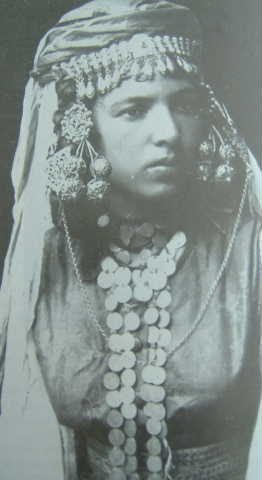 The Saharan Atlas, a vast area of exchange where nomads and settled people lived side by side, was ideal for a rich jewellery craft. Jewellers had their workshops in town, but nomadic life spread their work far and wide; as late as the 1940s and 1950s they would leave their shops for months to follow the nomads or settle in small villages. From the Ksour Mountains to the edge of the Aurès, through the Djebel Amour and the Ouled Naïl Mountains, traditional jewellery shows a real unity of style.
Jewellers preferred to settle in the large centres — El-Bayadh, Djelfa, Bou-Saada — where customers were many and varied: town women, women from the ksour and villages, passing nomads. Tastes differed (town women preferred gold), though the forms remained much the same.
Women in these regions favoured head ornaments: diadems, earrings, clasps, head pendants and chin straps.
There are two types of diadem : the mchebek or harsa, in gold or silver, made of openwork plaques set with coloured glass and small pendants (ostrich feathers were once added); and the silver haslilou worn by nomad women, made of small hollow elements shaped like date stones (noya), which could also be worn as a necklace.
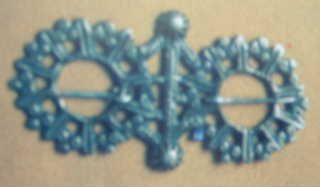 Earrings come in two models, saw-toothed (mcharaf) or with an openwork half-sphere (khorsa), often worn three or four to each ear.
Temple pendants (chenag or hmala) are triangular, with a hook or ring and small pendants.
Necklaces are mostly made of coins (cherka and chentouf) or of chains holding ktoubs, square amulet boxes.
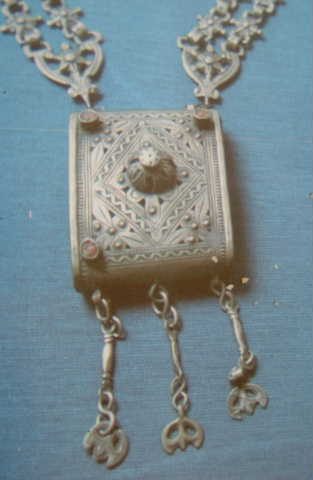 Besides common brooches such as the hzaim, the Djebel Amour has a rarer model related to Moroccan brooches; large circular brooches decorated with coins (semacha medouar)
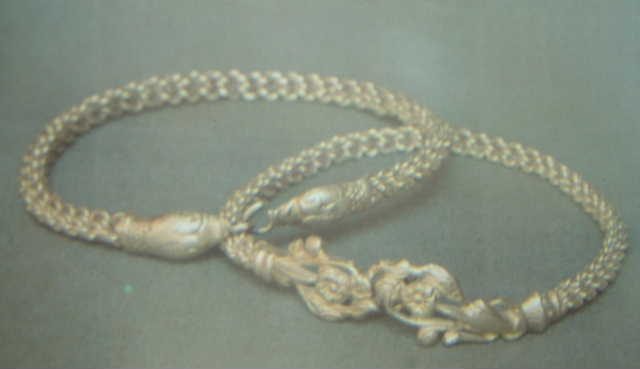 and thick ring-shaped brooches made by the Ouled Naïl jewellers are also found.
Bracelets (mquias) are openwork or solid; bracelets with large spikes (dah or couar) are typical of the region. Among anklets, the openwork daoudi with small flower-shaped plaques and the twisted-wire brim are characteristic of the Saharan Atlas.
Source: Bijoux algériens, El Holay El-Djazairia, Palais de la Culture
Catalogue of the exhibition organised by the national agency for the processing and distribution of gold and other precious metals (AGENOR) and the directorate for the promotion of cultural heritage
With the support of the Palais de la Culture and the Bardo National Museum
Exhibition design: T. Benfoughal, curator at the Bardo National Museum.