Painters, poets, writers · Gallery 23 / 29
At the heart of art, at the heart of life…

Isabelle Eberhardt 1877-1904
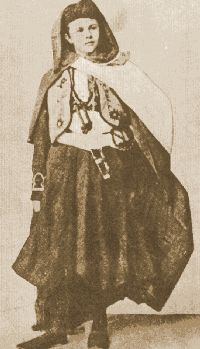
Isabelle Eberhardt was born in Geneva on 17 February 1877. She was the illegitimate daughter of Russian refugees: Natalia de Moerder, née Eberhardt, and Alexander Nikolayevich Trofimovsky, known as Vava. Legend sometimes names the poet Arthur Rimbaud as her father.
In May 1897 Isabelle Eberhardt made her first journey to Algeria, with her mother. Both women converted to Islam, and Isabelle took the Arab male pseudonym of Mahmoud. In June 1899 Isabelle and her brother Augustin went to Tunis. Isabelle continued alone towards Algeria. Disguised as a man, she wore a white burnous and a turban. The confusion surrounding her identity (a woman dressed as a man, calling herself Mahmoud Saadi but holding a Russian passport in the name of Isabelle de Moerder) troubled the authorities: she was expelled from Algeria. In 1901, in Marseille, she met Slimène Ehnni, a soldier in the native cavalry corps, whom she married. In 1902 Isabelle Eberhardt resumed her travels in the desert. She passed through Bou-Saada and the zaouia of El-Hamel several times. She went off for longer and longer across the vastness of the Sahara. Her travels were published regularly in L'Akhbar, where she had a column. In her short stories, so rich in colour and atmosphere, Isabelle Eberhardt did not hesitate to defend the fellahs and to speak out against colonisation.
21 October 1904 was Isabelle Eberhardt's last day. That day the town of Aïn Sefra was struck by a natural disaster: the oued turned into a raging torrent and the town was swept away. Isabelle was found in the ruins of her house, dressed in her Arab horseman's clothes. She was buried in the Muslim cemetery. Taken at the age of 27, Isabelle Eberhardt left many short stories and travel accounts written during her romantic life. Of death she wrote, in Dans l'ombre chaude de l'Islam:
All the great, poignant charm of life perhaps comes from the absolute certainty of death. If things were to last, they would seem to us unworthy of attachment.
Isabelle Eberhardt, Dans l'ombre chaude de l'Islam (In the Warm Shadow of Islam)