Painters, poets, writers · Gallery 29 / 29
At the heart of art, at the heart of life…
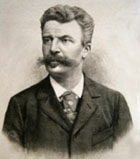
Guy de Maupassant 1850-1893
Le Zar'ez — extract from Au soleil (In the Sun)
Orientalism was also often steeped in exoticism, paternalism and racism. Here, as an example, is an extract from the work of one of the greatest French writers and poets of the 19th century, Guy de Maupassant (1850-1893), describing Arabs, Mozabites and Jews in Bou-Saada all in a jumble.
Bou-Saada as seen by Maupassant (extract)
(…) And suddenly, coming out of another pass, I saw the oasis before me.
It is an unforgettable apparition. You have just crossed endless plains and climbed sharp, bare, scorched mountains without meeting a tree, a plant, a green leaf, and here before you, at your feet, is an opaque mass of dark greenery, something like a lake of almost black foliage spread over the sand. Then, behind this great patch, the desert begins again, stretching away to infinity, to the elusive horizon where it merges with the sky.
The town slopes down to the gardens.
What towns they are, these cities of the Sahara! A cluster, a heap of cubes of sun-dried mud. All these square huts of hardened mire are stuck against one another, leaving between their capricious lines only narrow galleries — the streets — like the corridors traced by the regular passage of animals.
The whole city, moreover, this poor city of watered-down earth, makes one think of the constructions of some animal or other, of beavers' lodges, of shapeless works built without tools, with the means nature has left to creatures of a lower order. Here and there a magnificent palm tree spreads out twenty feet above the ground. Then suddenly you enter a forest whose paths are enclosed between two high clay walls. To the right, to the left, a crowd of date palms opens its broad parasols above the gardens, sheltering under its thick, cool shade the delicate throng of fruit trees. Under the protection of these giant palms, which the wind stirs like great fans, grow vines, apricot trees, fig trees, pomegranates and invaluable vegetables.
The water of the river, kept in large reservoirs, is distributed to the properties as gas is in our countries. A strict administration keeps an account for each inhabitant, who, by means of channels, has the use of the spring for one or two hours a week according to the size of his property.
Wealth is reckoned by the number of palm trees. These trees, guardians of life, protectors of sap, keep their feet constantly in water while their heads bathe in fire.
The little valley of Bou-Saada, which brings the river to the gardens, is as marvellous as a dream landscape. It descends, full of date palms, fig trees and great magnificent plants, between two mountains with red summits. All along the swift stream, Arab women with veiled heads and bare legs wash their linen by dancing on it. They roll it in a heap in the current and beat it with their bare feet, swaying gracefully.
The river runs and sings along this ravine. On leaving the oasis it is still abundant; but the desert awaiting it, the yellow, thirsty desert, drinks it at once at the gates of the gardens and abruptly swallows it in its sterile sands.
When you climb the mosque at sunset to look at the whole town, the sight is most peculiar. The flat square roofs form a kind of cascade of mud chequerboards or dirty handkerchiefs. On them bustles the whole population, which climbs onto its huts as soon as evening comes. In the streets you see no one and hear nothing; but as soon as you look down on all the roofs from a height, there is extraordinary movement. Supper is being prepared. Clusters of children in white rags swarm in the corners; that shapeless bundle of dirty linen that represents the Arab woman of the people is cooking the couscous or working at some task.
Night falls. Then the carpets of the Djebel Amour are spread on the roof, after the scorpions that swarm in these hovels have been carefully chased away; and the whole family falls asleep in the open air beneath the sparkling swarm of the stars.
The oasis of Bou-Saada, though small, is one of the most charming in Algeria. In the surrounding country you can hunt the gazelle, which is found there in numbers. There are also plenty of the fearsome léfaa and even the hideous long-legged tarantula, whose enormous shadow can be seen running over the walls of the huts in the evening.
Quite a considerable trade is carried on in this ksar, because it lies somewhat on the road to the Mzab.
The Mozabites and the Jews are the only merchants, the only traders, the only industrious beings in all this part of Africa.
As soon as one advances into the south, the Jewish race appears in a hideous light that makes one understand the ferocious hatred of certain peoples against these people, and even the recent massacres. The Jews of Europe, the Jews of Algiers, the Jews we know and rub shoulders with every day, our neighbours and our friends, are men of the world, educated, intelligent, often charming. And we are violently indignant when we learn that the inhabitants of some small, unknown, distant town have slaughtered and drowned a few hundred children of Israel. I am no longer surprised today; for our Jews hardly resemble the Jews over there.
In Bou-Saada one sees them crouching in filthy dens, bloated with fat, sordid, lying in wait for the Arab as a spider lies in wait for a fly. They call him over and try to lend him a hundred sous against a note he will sign. The man knows the danger, hesitates, refuses. But the desire to drink, and other desires, tug at him. A hundred sous represent so many pleasures for him!
At last he gives in, takes the silver coin and signs the greasy paper.
After three months he will owe ten francs, a hundred francs after a year, two hundred francs after three years. Then the Jew has his land sold, if he has any, or otherwise his camel, his horse, his donkey — in short, everything he owns.
The chiefs — caïds, aghas or bachaghas — also fall into the clutches of these predators, who are the scourge, the bleeding wound of our colony, the great obstacle to the civilisation and well-being of the Arab.
When a French column goes to raid some rebel tribe, a swarm of Jews follows it, buying up the booty for next to nothing and selling it back to the Arabs as soon as the army corps has moved away.
If, for instance, six thousand sheep are seized in a district, what is to be done with them? Drive them to the towns? They would die on the way, for how could they be fed and watered across the two or three hundred kilometres of bare land to be crossed? Besides, to take and guard such a convoy would need twice as many troops as the column has.
Kill them, then? What a massacre and what a waste! And there are the Jews, asking to buy at two francs apiece sheep worth twenty. After all, the treasury will still gain twelve thousand francs. So they are sold to them.
A week later the original owners have bought back their sheep at three francs a head. French vengeance comes cheap.
The Jew is master of the whole south of Algeria. There is hardly an Arab, indeed, who is not in debt, for the Arab does not like to pay back. He prefers to renew his note at a hundred or two hundred per cent. He always thinks he is saved when he gains time. A special law would be needed to change this deplorable situation.
Moreover, throughout the South the Jew practises little but usury, by the most dishonest means possible; the real traders are the Mozabites. When you arrive in any village of the Sahara, you at once notice a whole particular race of men who have taken over the business of the country. They alone have shops; they keep the goods from Europe and those of local industry; they are intelligent, active, traders at heart. They are the Beni-Mzab or Mozabites. They have been nicknamed the “Jews of the desert”.
The Arab, the true Arab, the man of the tent, for whom all work is dishonourable, despises the Mozabite trader; but at fixed times he comes to stock up in his shop, and entrusts him with the valuables he cannot keep in his wandering life. A kind of permanent pact is established between them.
The Mozabites have thus seized all the trade of North Africa. They are found as much in our towns as in the Saharan villages. Then, his fortune made, the merchant returns to the Mzab, where he must undergo a kind of purification before recovering his political rights.
These Arabs, recognisable by their stature — shorter and stockier than that of other peoples — by their often flat and very broad faces, their thick lips and their eyes generally deep-set under a straight, very bushy brow, are Muslim schismatics. They belong to one of the three dissident sects of North Africa, and some scholars believe them to be the present-day descendants of the last followers of Kharijism. Their country is perhaps the strangest in the whole of Africa.
Their fathers, driven from Syria by the arms of the Prophet, came to live in the Djebel Nefoussa, west of Tripoli in Barbary.
But, driven successively from every place where they settled, envied everywhere for their intelligence and industry, and suspected too because of their heterodoxy, they finally stopped in the most arid, most scorching, most dreadful region of all. In Arabic it is called Hammada (the heated) and Chebka (the net), because it looks like an immense net of black rocks and stones.
The country of the Mozabites lies about a hundred and fifty kilometres from Laghouat.
Here is how Commandant Coyne, the man who knows the whole south of Algeria best, describes his arrival in the Mzab in a most interesting pamphlet:
“Roughly in the centre of the Chebka is a kind of cirque formed by a ring of very shiny limestone rocks with very steep slopes on the inside. It is open to the north-west and south-east by two cuttings through which the Oued Mzab passes. This cirque, about eighteen kilometres long and at most two kilometres wide, contains five of the towns of the Mzab confederation and the land that the inhabitants of this valley cultivate exclusively as gardens.
“Seen from outside, from the north and east, this ring of rocks looks like a cluster of koubbas tiered one above the other without any kind of order; it might be an immense Arab necropolis. Nature itself seems dead. There, no trace of vegetation rests the eye; even the birds of prey seem to flee these desolate regions. Only the rays of an implacable sun are reflected on these greyish-white walls of rock, producing fantastic patterns with the shadows they cast.
“So great, then, is the astonishment — I would even say the enthusiasm — of the traveller when, reaching the crest of this line of rocks, he discovers inside the cirque five populous towns surrounded by gardens of luxuriant vegetation, standing out dark green against the reddish bed of the Oued Mzab.
“Around him, the bare desert, death; at his feet, life and the clear proofs of an advanced civilisation.”
The Mzab is a republic, or rather a commune of the kind the Paris revolutionaries tried to establish in 1871.
No one in the Mzab has the right to remain idle; as soon as a child can walk and carry something, he helps his father water the gardens, which is the constant and greatest occupation of the inhabitants. From morning to night, the mule or camel draws in a leather bucket the water that is then poured into a channel so ingeniously organised that not one drop of the precious liquid is lost.
The Mzab also has a great many dams to store the rains. It is thus infinitely more advanced than our Algeria.
Rain! For the Mozabite it means happiness, assured comfort, the harvest saved; so as soon as it falls, a kind of madness seizes the inhabitants. They pour into the streets, fire their guns, sing, run to the gardens, to the river that has begun to flow again, and to the dykes, whose upkeep is the duty of every citizen. As soon as a dyke is threatened, everyone must go to it.
And these people, by their constant work, their industry and their wisdom, have turned the wildest and most desolate part of the Sahara into a living, planted, cultivated country where seven prosperous towns spread out in the sun. So the Mozabite is jealous of his homeland and keeps Europeans out of it as much as possible. In some towns, such as Beni-Isguen, no stranger has the right to spend even a single night.
Policing is done by everyone. No one would refuse to lend a hand if needed. There are neither poor nor beggars in this country. The needy are fed by their community.
Almost everyone can read and write.
Everywhere there are schools and large communal buildings. And many Mozabites, after spending some time in our towns, return home speaking French, Italian and Spanish.
Commandant Coyne's pamphlet contains countless surprising details about this curious little people.
In Bou-Saada, as in all the oases and all the towns, it is the Mozabites who carry on trade and exchange, keep shops of every kind and practise every profession.
After four days in this little Saharan town, I set off again for the coast.
The mountains you meet heading towards the coast have a strange appearance. They look like monstrous fortresses with kilometres of battlements. They are regular, square, cut in a mathematical way. The highest is flat and seems inaccessible; its shape has earned it the nickname of “the Billiard Table”. Shortly before I arrived, two officers had managed to climb it for the first time. On the summit they found two enormous Roman cisterns.